
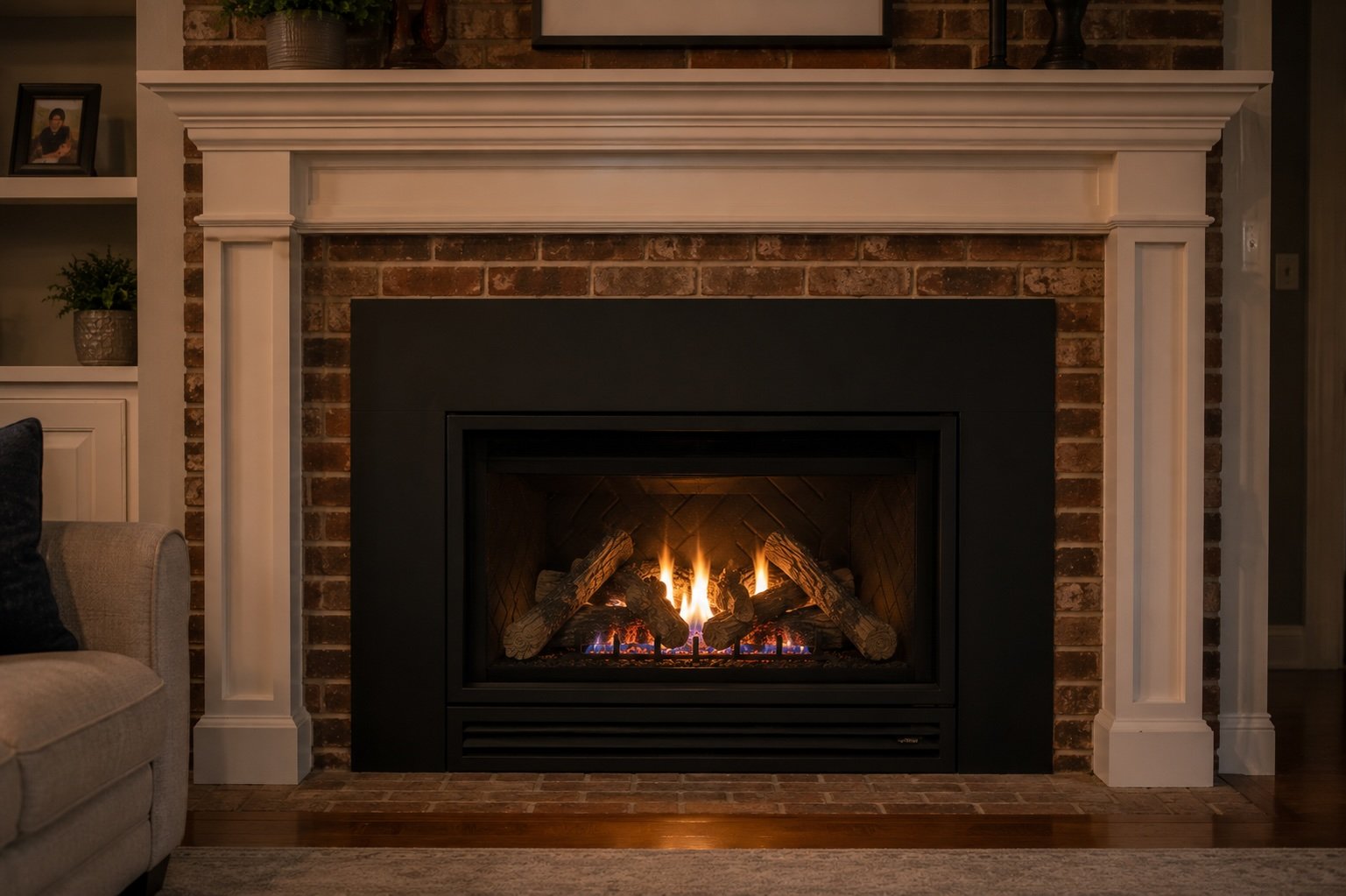
Every winter we get called out to the same thing: white chalky staining bleeding through the brick on the outside of a chimney, six or eight feet up. The homeowner wants to know if there’s a leak.
Sometimes there is. Often enough, it turns out to be the fireplace.
The pattern goes like this. Gas logs went in eight or nine years ago — a burner and a set of ceramic logs sitting in the original masonry firebox, damper clamped permanently open the way code requires. Nice looking fire. Push a button, flames come up, no wood to haul.
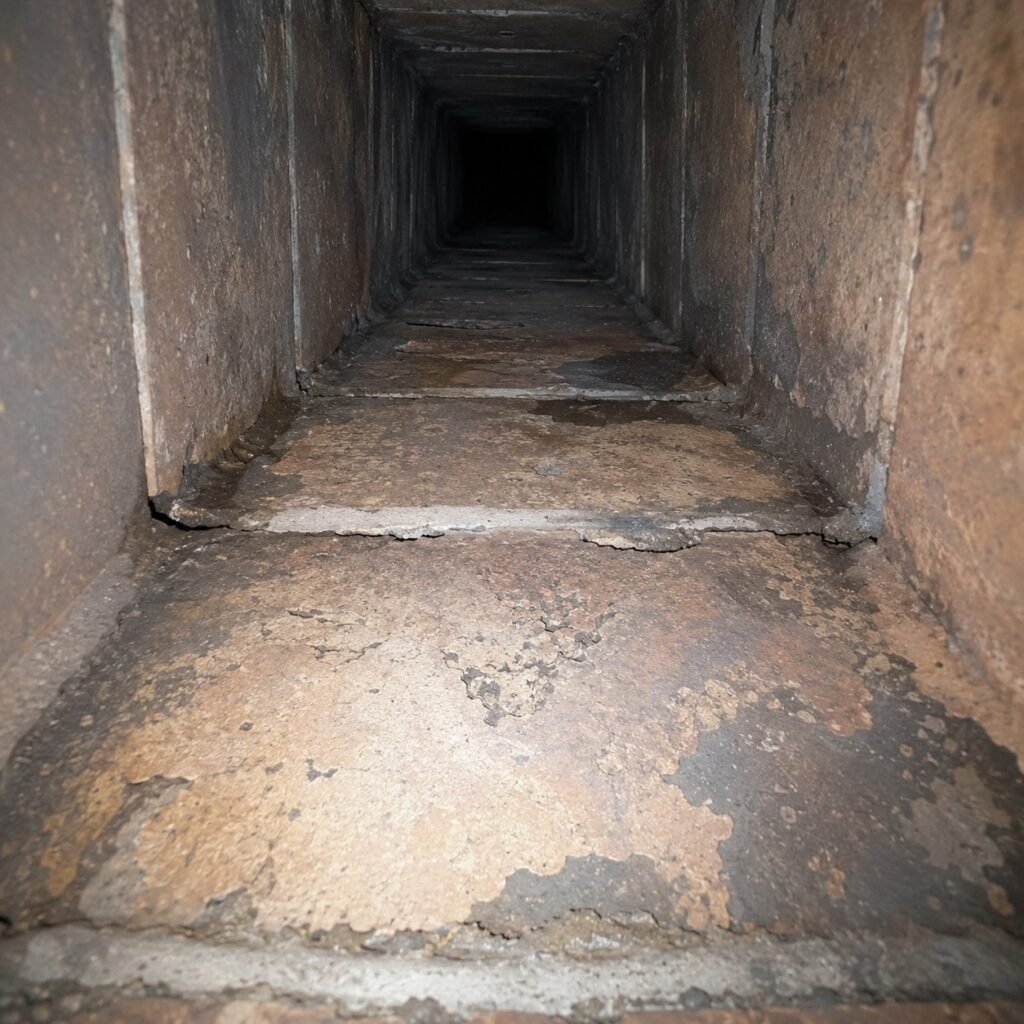
But everything above that firebox is still the chimney a wood fire built. Original clay tile, sized for burning oak. Nine winters of gas exhaust have been drifting up that oversized cold flue, cooling on the way, condensing on the tile. The bottom tiles are flaking apart at the faces. The mortar joints between them have washed out. The moisture has worked into the brick and come out the other side as the staining that prompted the call.
The gas logs worked fine the entire time. That’s the problem. Nothing ever told anybody something was wrong.
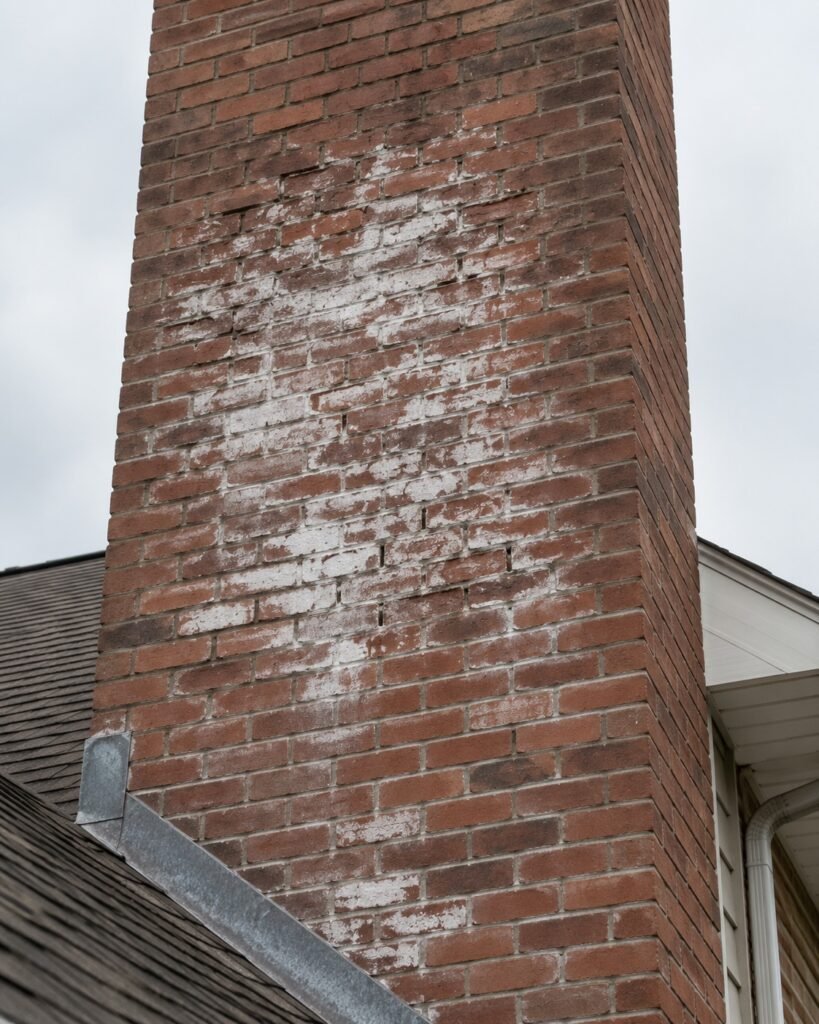
First: gas logs and a gas insert are not the same appliance
People say “gas fireplace” for both, and showrooms don’t always slow down to explain the difference. It matters more than almost anything else in this decision, because the two appliances treat your chimney in completely opposite ways.
A gas log set is a burner with ceramic logs on it, set into your existing open masonry fireplace. The firebox stays open. The damper gets clamped permanently open so the fireplace can never be closed on a running burner. The exhaust goes up the flue you already have, exactly as it is. It’s a decorative appliance first — a yellow, wood-looking flame — and most of the heat it makes goes straight up the chimney with the exhaust. That’s not a defect. That’s what it is.
A gas insert is a sealed firebox that goes into the fireplace opening and brings its own venting with it. Glass front, closed combustion, a blower. It cannot be legitimately installed without a listed vent running the full height of the chimney to a proper termination at the top — direct-vent coaxial pipe, or a co-linear pair of flex liners, depending on the unit. Once that’s in, your masonry flue isn’t a flue anymore. It’s a chase: a hollow shaft that the appliance’s own vent pipe passes through. Nothing from the burn ever touches the clay tile.
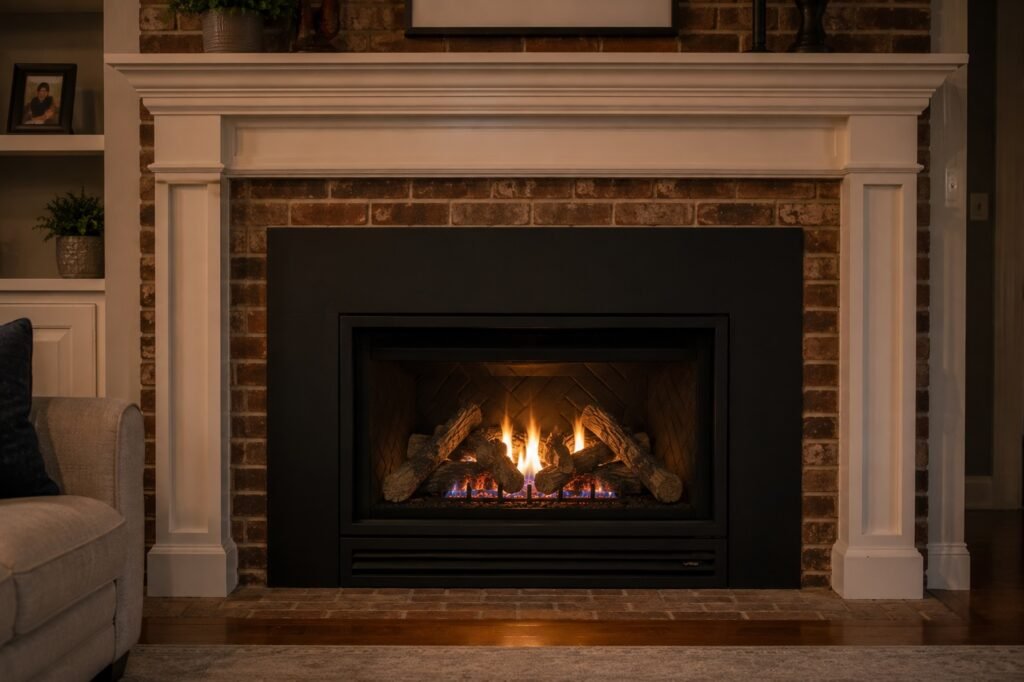
That single structural difference is the whole story. One appliance uses your old chimney as its exhaust path. The other one bypasses it entirely.
What’s actually coming out of a gas flame
Gas burns clean in the sense people mean it — no creosote, no soot worth speaking of, no smoke. That’s real, and it’s why gas logs get sold as the low-maintenance option.
But water is not a side effect of burning natural gas. It’s a main product of it. The chemistry is straightforward: methane plus oxygen gives you carbon dioxide and water vapor, two molecules of water for every molecule of gas burned. Run the numbers and it comes to roughly a gallon of water for every 100,000 BTU.
A wood fire carries its exhaust out hot and fast and keeps the flue dry doing it. A gas appliance runs cooler and much wetter. Now put that cool wet exhaust into a big clay flue built for a wood fire — which is to say enormously oversized for a gas burner — on a January night when that masonry is sitting at outdoor temperature. The exhaust slows down. It cools. And it condenses on the tile.
That condensate is mildly acidic. It eats mortar joints. It spalls the faces off clay tile. It soaks into the masonry, and then Virginia’s freeze-thaw winter takes over and finishes what the acid started. This is not fast and it is not dramatic. It’s nine years of nothing appearing to happen, and then a chimney that needs relining.
So which appliance does that to you?
The gas log set. Almost exclusively.
Not because it’s a bad product — it’s a legitimate appliance, properly installed all over Northern Virginia, and there’s nothing wrong with wanting a fire you turn on with a switch. The reason is simply that a vented gas log set is permitted to use your existing flue as-is. No liner is required. So the default install is: burner in, logs arranged, damper clamped, done. Whether your particular flue is a reasonable exhaust path for a gas burner is a question nobody is required to ask.
A gas insert can’t fail that way, because the full-height vent isn’t optional. The pipe runs to the top or the install isn’t finished. Every insert we look at either has a complete vent or has an installation problem you can see immediately.
If you’re weighing the two, that’s a real point in the insert’s favor and nobody in a showroom is going to make it for you: the insert costs more up front and protects the chimney, and it’s a genuine heater besides — most open masonry fireplaces are net heat losers, and a log set doesn’t change that arithmetic much where an insert reverses it. The log set costs less up front and puts the chimney at risk.
If you go with logs anyway — and plenty of people should, if what you want is the look — have the flue looked at first and know what you’re starting with.
The third option: vent-free, and why we don’t love it
There’s a category that skips the chimney entirely. Vent-free (or “ventless”) log sets have no vent at all. They burn room air and release the combustion products back into the room, on the theory that they burn cleanly enough for that to be acceptable.
Two things to know. Building code restricts where these can go — bedrooms and bathrooms are the standard prohibitions, and your county inspector is the final word on your specific installation. And remember that water figure: a 25,000 BTU vent-free unit running four hours on a cold evening puts something like a quart of water into your house, and it has nowhere to go. In a tight modern home that shows up as condensation on the windows and, over a full winter, sometimes as mold complaints. We’d rather see a vented appliance.
Switching fuel means a Level 2 inspection
This one isn’t our opinion. Under NFPA 211 — the national standard for chimneys, fireplaces, and venting — a Level 2 inspection is called for whenever the system changes: a new appliance, a different appliance, or a change of fuel. Going from wood to gas is all three at once. It doesn’t matter which gas appliance you picked.
A Level 2 goes past what’s visible from the room. It covers the accessible areas most people never see — attic, crawlspace, basement — plus the internal surfaces of the flue itself. It’s how you find out whether the chimney you’re about to convert is sound enough to accept the change, and, if you’re putting in logs, whether that flue is a defensible exhaust path for them at all.
Ours is $249, the same price whether it’s for a home sale or a fuel conversion. Get it before the install, not after — it’s by a wide margin the cheapest way to find out what that flue actually needs while the firebox is still open and easy to reach. Once the appliance is set and the surround is finished, the same repair means pulling it all back out. And if that fireplace burned wood, get the creosote swept out while you’re at it, because nothing about the new setup is going to remove it.
We also do relining as a stand-alone service. If the Level 2 turns up a flue that can’t take gas exhaust as-is, that’s the fix — and it’s a much better conversation to have in advance than in year nine.
No smoke doesn’t mean no inspection
This is the single most common misunderstanding we run into. No soot, no creosote, no smoke — so nothing to inspect, right?
Wrong in a few specific ways, and every one of them applies to both appliances.
Carbon monoxide. A wood fire announces itself when something’s off. You smell smoke. Gas doesn’t do that. CO has no color, no odor, no taste, and a blocked or separated vent is exactly the mechanism that delivers it into your house. Working CO alarms on every level of the home are non-negotiable with any gas appliance. No exceptions, no arguments.
Spiders, honestly. Natural gas is odorless on its own — that rotten-egg smell is mercaptan, added so leaks get noticed. A particular spider is attracted to it and spins webs directly in burner ports and orifices. Blocked ports mean incomplete combustion, which means more CO and a burner that lights badly or won’t light at all. It’s a well-documented failure mode, and it’s a summer problem: the unit sits idle for eight months and something moves in.
Everything else that lives up there. Birds and squirrels nest in flues and vent terminations during the off season. A blockage on a gas system doesn’t make a visible mess in your living room the way a blocked wood flue does. It just quietly stops venting correctly.
The chimney is still a chimney. Crown cracks, failed flashing, deteriorating mortar, water intrusion — none of that cares what fuel you burn. It’s exposed masonry in a climate that freezes and thaws all winter long.
An annual inspection on a gas system means checking the venting path end to end, the condition of the liner or tile and the masonry around it, the termination at the top, and whether anything has taken up residence.
The bottom line
Gas logs and a gas insert are two different appliances that happen to sit in the same hole in your wall.
The insert brings its own vent, runs it the full height of the chimney, and turns your flue into a chase it never touches. It costs more and it’s the better outcome for the masonry — and it actually heats the room.
The log set uses the chimney you’ve already got, exactly as it is, and that’s where the slow damage comes from: cool wet exhaust condensing in an oversized cold flue, year after year, with nothing visible to warn you.
Either way, the move is the same. Get a Level 2 before you convert and find out what that flue is really made of. Sweep the creosote out first. Then put the system on the same annual schedule you’d give any chimney — because the failures that matter with gas are the quiet ones. No smoke to warn you, no soot to give it away, just a venting path that stopped doing its job sometime last spring.
If you’ve got gas logs or an insert anywhere in our Northern Virginia service area and nobody’s been up there in a few years, schedule an inspection. And if you’re still shopping, call before you sign — what’s above that firebox will tell you a lot about which quote is realistic. We install gas log sets and gas fireplace inserts, and we convert wood-burning fireplaces to gas, so with us that conversation starts at the flue instead of ending there. Installs and conversions are quoted after an inspection, not off a price list.
America One Inc. · Virginia Class A Contractor License #2705175986
0 Comments