
The fire that started in the flue
A customer in Woodbridge called us two winters ago, more embarrassed than scared — at first.
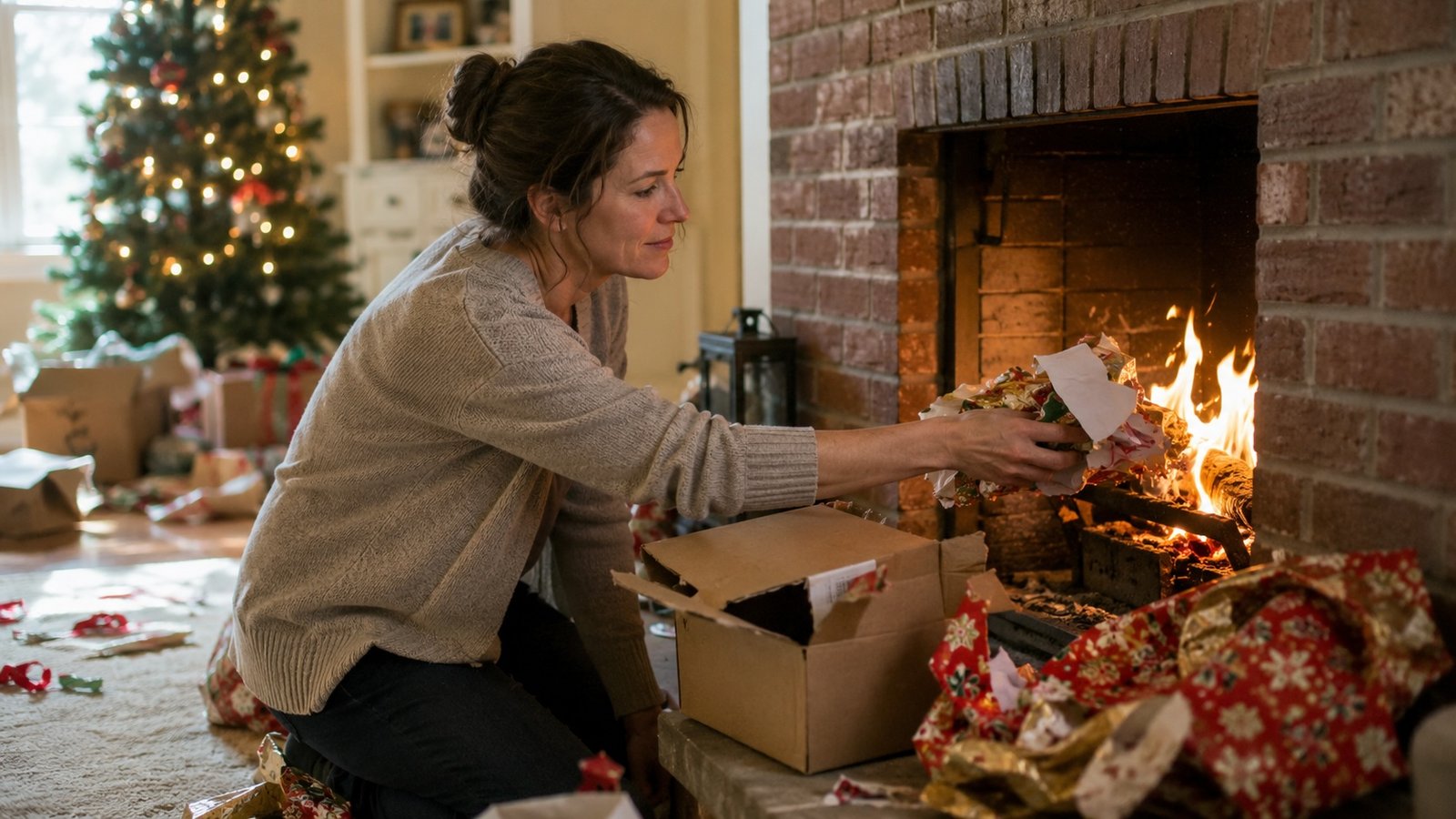
Christmas morning. Wrapping paper everywhere. Instead of bagging it up, the family fed it into the fireplace, sheet after sheet, watching it flare up big and bright while the kids cheered.
What they couldn’t see was what those flaming sheets were doing above the damper. Burning paper doesn’t stay in the firebox. It lifts. Feather-light, still on fire, riding the draft straight up the flue — into a chimney lined with three seasons of creosote nobody had swept.
The neighbor saw it first: flames coming out of the top of the chimney like a roman candle. Fire department, two trucks, a Christmas morning the kids will definitely remember.
The house survived. The flue liner didn’t.
Here’s the thing — that fire needed two ingredients, and most homeowners are stocking both without knowing it: creosote in the chimney, and the wrong fuel in the firebox. Let’s talk about where each one comes from.
What “seasoned” actually means
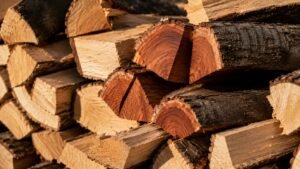
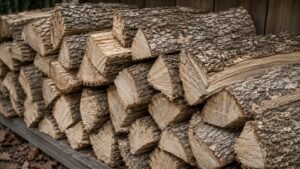
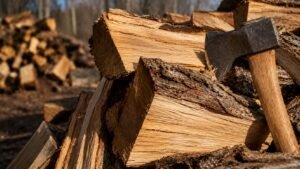
Seasoned firewood is wood that’s been split, stacked, and left to dry — usually six months to a year, sometimes longer for oak — until its moisture content drops below about 20 percent.
Freshly cut (“green”) wood can be closer to half water by weight. When you burn it, most of your fire’s energy goes into boiling that water off instead of heating your home. The fire smolders. The smoke runs cool and heavy.
And that cool, heavy smoke is exactly how creosote is born.
Creosote: the slow-motion house fire
Creosote is what happens when smoke doesn’t leave your chimney fast enough or hot enough. The unburned particles and vapors condense on the inside of your flue — first as a flaky soot, then a crunchy tar, and eventually a hard, shiny glaze that’s about as easy to remove as it sounds.
Every fire you burn with wet wood adds a coat.
Here’s the chain reaction, step by step. Wood above roughly 20 percent moisture can’t burn clean — the fire has to boil the water out before it can burn the wood, and boiling water caps the temperature of the whole firebox. A cool fire means incomplete combustion: instead of burning off, the tars and gases in the wood leave as thick, heavy smoke. That smoke rises into a flue that never got hot, and when smoke touches a flue surface below about 250°F, the tar in it condenses on contact — the same way a cold glass sweats on a summer day, except what’s beading up is flammable.
Burn wet wood all season and you run that cycle hundreds of times. By spring, the coating has stages: first-degree creosote is flaky soot a brush removes easily. Second-degree is crunchy tar that takes real work. Third-degree is that shiny hardened glaze — baked on, brush-proof, and the most flammable of the three. That’s the stage where a sweep stops being maintenance and starts being a rescue operation.
Creosote is not soot. Creosote is fuel. It ignites at high temperatures, and when it does, the fire isn’t in your fireplace anymore — it’s inside the structure of your chimney, burning at temperatures your flue was never built to hold. That’s a chimney fire. Some announce themselves with a freight-train roar and flames at the chimney top. Others burn quietly, crack the liner, and wait for the next fire to finish the job.
The math is simple: dry wood burns hot and clean, so smoke exits fast with little left to condense. Wet wood burns cool and dirty, and your flue collects the difference.
Why paper and cardboard are a different kind of dangerous
If wet wood is the slow problem, paper is the fast one.
Paper and cardboard burn hot, fast, and light. That combination is exactly wrong for a fireplace:
Flaming pieces go airborne. Wood embers are heavy and stay put. Burning paper lifts off and rides the draft up the flue — a lit match delivered directly to whatever creosote is waiting up there. If it makes it all the way out, it lands on your roof or your neighbor’s, still burning.
The temperature spike is violent. A firebox full of blazing cardboard can push a flash of heat up a flue faster than the masonry can absorb it — hot enough to ignite glazed creosote in one shot. Sudden extreme heat is also how flue tiles crack.
The fumes are worse than you think. Glossy paper, colored wrapping paper, magazine stock, and the inks and adhesives in cardboard release chemicals when they burn that you do not want drifting back into your living room — or coating the inside of your flue.
While we’re at it, the rest of the do-not-burn list: painted or pressure-treated lumber, plywood and particle board, driftwood (salt turns to corrosive — and toxic — chlorine compounds), household trash, plastics of any kind, and dried-out Christmas trees. That last one deserves its own warning: a dead evergreen is basically a bomb made of resin and needles. Every January, somebody learns this.
A sheet or two of plain newspaper to get kindling going? That’s fine — that’s what it’s for. A firebox stuffed with the weekend’s Amazon boxes? That’s how our Woodbridge story starts.
How to tell your wood is actually seasoned
You don’t need a lab. You need about thirty seconds:
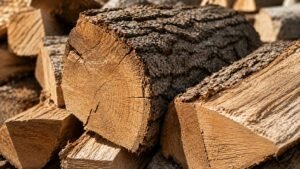
Look at the ends. Seasoned wood is gray, dull, and cracked at the cut ends — like it’s been through some things. Green wood looks fresh-cut and creamy.
Check the bark. On seasoned wood, bark loosens and falls away. On green wood, it’s holding on tight.
Knock two pieces together. Dry wood gives a sharp, hollow crack. Wet wood gives a dull thud.
Feel the weight. Water is heavy. If a split feels heavier than it looks, it’s still wet inside.
Or get the number instead of guessing — which brings us to the one tool every wood burner should own.
The fifteen-dollar tool that ends the guessing
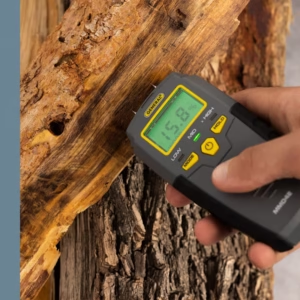
A moisture meter is a pocket-sized gadget with two metal pins. Press the pins into wood, and it tells you the moisture content as a percentage. Hardware store, big-box, or online — most run $15 to $30, and it’s the same basic tool we carry on our trucks.
Here’s how to use it so the number actually means something:
Split the log first. The outside of a log dries fast and lies to you. Split a piece and press the pins into the freshly exposed inner face — that’s the real moisture content.
Test more than one piece, and pull them from the middle of the stack, not the sun-baked top row.
Read the number. Over 20 percent: don’t burn it — stack it and give it more time. 15 to 20 percent: good, clean-burning firewood. Under 15 percent: excellent — light it up.
The meter earns its keep the day a cord of “seasoned” firewood arrives in your driveway. “Seasoned” on a roadside sign is a promise, not a fact — and you can’t tell 30 percent from 18 by looking. Pull three or four splits off the truck at random, split one, test it in front of the delivery guy. If it reads wet, you just saved yourself a winter of creosote with a fifteen-dollar tool. That’s the cheapest chimney protection money buys.
The other half of the equation
Burning right protects your chimney going forward. It doesn’t clean up what’s already in there.
The National Fire Protection Association (NFPA 211) recommends every chimney be inspected annually and swept whenever creosote has built up — and if you’ve spent a season or two burning wet wood, or your fireplace has been eating gift wrap every December, that buildup is already on the walls of your flue, waiting on a spark.
That’s the part we handle. A sweep clears the fuel out of your chimney; an inspection tells you whether past fires — the ones you knew about and the ones you didn’t — left cracks behind.
The bottom line
Your fireplace is designed to burn one thing: dry, seasoned firewood. Everything else is either robbing you of heat, coating your flue with fuel, or sending fire places it was never supposed to go.
Burn dry. Trust the meter, not the label. Keep the boxes and wrapping paper in the recycling bin. And before the burning season gets going, have the chimney looked at by somebody who knows what three seasons of creosote looks like from the inside.
America One Chimney Sweeps is a licensed VA Class A Contractor (License #2705175986), serving Northern Virginia homeowners with certified chimney inspections, sweeping, and repair.
Better a clean flue than a Christmas morning story.
Call us at 703-789-3639 to schedule your annual chimney inspection and sweep.
0 Comments